 Join Our What’sApp Channel for updates, guidance, and tips on the application process.
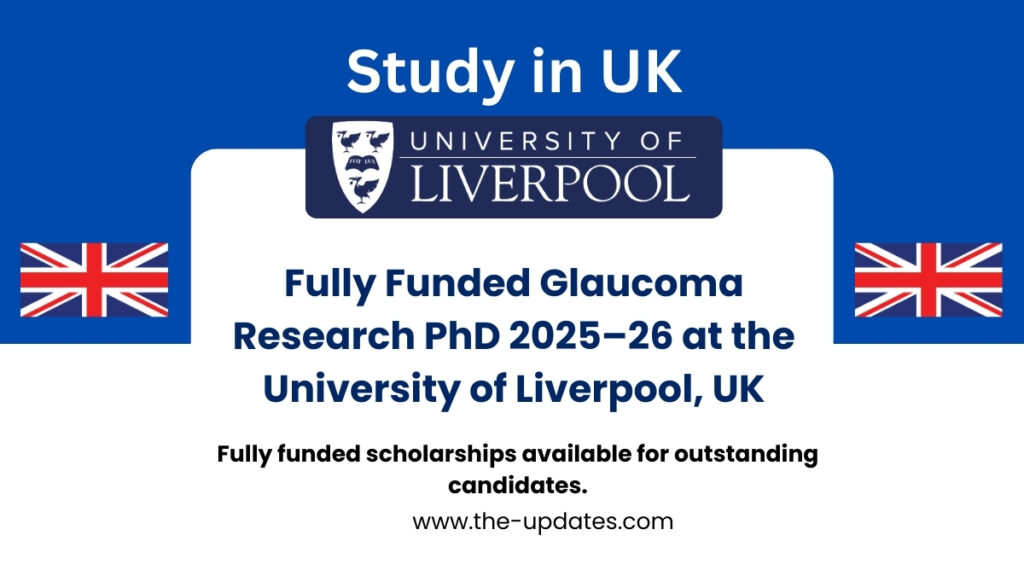
Fully Funded Glaucoma Research PhD 2025–26 at the University of Liverpool, UK
Glaucoma is the leading cause of irreversible blindness worldwide, affecting millions and projected to impact over 112 million people by 2040. The University of Liverpool, one of the UK’s most respected research institutions, is offering a PhD opportunity in glaucoma research for the 2025–2026 academic year.
While the position is officially self-funded, eligible candidates can apply for fully funded scholarships, such as the Duncan Norman Research Scholarship, which provides full tuition coverage and a generous living stipend.
This program offers the chance to work within a multidisciplinary team of scientists, clinicians, and engineers in the fields of regenerative medicine and ocular health — all while living in one of the UK’s most vibrant and affordable cities.
About the University of Liverpool
Founded in 1881 and a member of the Russell Group, the University of Liverpool is internationally recognized for its research excellence in life sciences, engineering, and medical sciences.
The Institute of Life Course and Medical Sciences, where this PhD project is based, is home to world-class facilities and researchers. The University welcomes over 8,000 international students annually, fostering a truly global learning environment.
Project Focus
The research aims to develop innovative biomaterials and surgical procedures to improve glaucoma treatment by addressing the pathobiology of aqueous humour (AH) outflow, a key factor in regulating intraocular pressure (IOP) — the main modifiable risk factor for glaucoma progression.
Supervisory expertise includes:
Ocular cell and stem cell biology
Biomedical and tissue engineering
Regenerative medicine
Ophthalmology and clinical eye health
Why This Research Matters
Current glaucoma treatments mainly target lowering IOP, yet many patients still experience vision loss. This project will integrate in vitro models, organ-on-a-chip systems, and ex vivo surgical assessments to advance:
Early diagnosis methods
Targeted drug delivery
Improved surgical techniques
Research Training and Skills Development
As a PhD candidate, you will gain expertise in:
Cell and stem cell biology (tissue culture, mRNA and protein assays)
Confocal and live-cell imaging
In vitro and ex vivo functional analysis
Surgical simulations and ex vivo eye surgery
Organ-on-a-chip modelling for ocular systems
Funding Opportunities (Fully Funded Pathways)
1. Duncan Norman Research Scholarship
Full tuition fee coverage (UK or international rate)
Annual living allowance of £17,000
Research support allowance
One award granted annually
2. UK Doctoral Loan
Up to £30,301 for eligible UK nationals or settled residents
3. External Funding
Opportunities from glaucoma and vision research charities
Grants from bodies such as the Medical Research Council (MRC) or Wellcome Trust
4. Sport Liverpool Performance Programme
For high-performing athletes, offering training and physiotherapy support to reduce living expenses indirectly
Eligibility Criteria
Preferred academic backgrounds:
Biology
Medicine
Biomedical sciences
Health sciences
Biomedical engineering
Additional requirements:
First or Upper Second-Class Honours degree (or international equivalent)
English proficiency (IELTS 6.5 or above, if applicable)
Strong research interest in regenerative medicine, ophthalmology, or tissue engineering
Application Process
Step 1 – Contact Supervisors
Send your CV and cover letter to:
Dr Carl Sheridan – carlos@liverpool.ac.uk
Dr Neeru Vallabh
Dr Lucy Bosworth
Your cover letter should outline your academic background, motivation for glaucoma research, relevant skills, and your funding plans.
Step 2 – Prepare Supporting Documents
Research proposal
Degree transcripts and certificates
Passport details (for international applicants)
English language certificate (if applicable)
Personal statement
Two academic references
Step 3 – Formal Application
If shortlisted after the initial review, you will be invited to submit an official application via the University of Liverpool’s online portal.
Why Choose Liverpool for Your PhD?
Research Excellence: Join a globally recognized team in ocular and regenerative medicine.
Career Opportunities: Build transferable skills for academia, healthcare, and biotech industries.
Vibrant City Life: Liverpool offers cultural diversity, friendly communities, and affordable living.
Professional Networking: Present at international conferences and publish in leading journals.
Key Dates
Applications: Open year-round
Suggested funding application deadline: December 2025 (for October 2026 start)
Tuition Fees (2025–26)
UK/ROI: £5,006 per year
International: £31,250 per year
FAQs
1. Is the PhD fully funded?
The PhD is officially self-funded, but fully funded scholarships such as the Duncan Norman Research Scholarship are available for exceptional candidates.
2. Can international students apply?
Yes. The program is open to both UK and international students.
3. What is the main focus of the research?
The project focuses on developing new treatments for glaucoma through biomaterials, regenerative medicine, and surgical innovations.
4. What are the eligibility requirements?
A relevant degree (First or Upper Second-Class Honours or equivalent), English proficiency, and an interest in regenerative medicine or ophthalmology.
5. When should I apply for funding?
It is recommended to apply for funding by December 2025 for an October 2026 start date.
6. How long does the PhD take to complete?
Typically, full-time PhDs at the University of Liverpool take three to four years to complete.
7. What is intraocular pressure (IOP)?
IOP is the fluid pressure inside the eye. Elevated IOP is a major risk factor for glaucoma progression.
8. What is organ-on-a-chip technology?
It is a micro-engineered system that mimics human organ functions, allowing advanced testing of treatments in laboratory settings.
9. How do I contact the supervisors?
Email Dr Carl Sheridan (carlos@liverpool.ac.uk) and copy Dr Neeru Vallabh and Dr Lucy Bosworth with your CV and cover letter.
10. Are there opportunities to present research internationally?
Yes. PhD candidates are encouraged to present at conferences and publish in peer-reviewed journals.